If you hire an SEO agency today, there is a meaningful chance you are paying them to optimize your site for 2020, not 2026.
We know this because we just ran the Top 100 SEO Agencies in the United States through GEO Stellar's deep-node architectural scanner — a platform built to view the web exactly the way OpenAI's and Google's do. We expected to find minor technical gaps. Instead, we found something more systemic: 30% of the top SEO agencies in America have strong brand authority but AI agents are physically blocked from navigating their sites. They are, in many cases, earning the reputation without capturing the citations.
The full research report is available as a free download — grab it here. What follows is the short version.
What We Built — And Why
Most GEO tools currently on the market track citation monitoring. They query ChatGPT or Perplexity and record whether your brand appears in the answer. That's valuable. But it measures the symptom, not the cause.
The cause is the upstream experience your website provides to the autonomous AI agents that power modern AI search. These agents — tools like OpenAI's and Google's — don't just crawl your HTML. They navigate your website the way a human would. They see your DOM. They read your ARIA labels. They try to interact with your CTAs. They evaluate your schema markup. And they decide, based on that navigation experience, whether your content is trustworthy and citable enough to include in an AI-generated answer.
GEO Stellar's deep-node scanner simulates exactly that experience. And in April 2026, we pointed it at the Clutch Top 100 US SEO Agencies.
The Headline Numbers
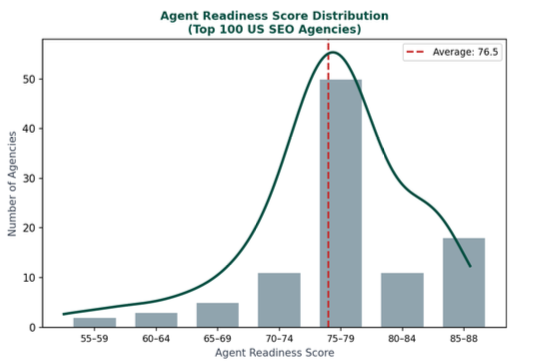
Across all 100 agencies, the average Agent Readiness Score was 76.5 out of 100. The distribution tells a more detailed story:
- 0 agencies scored 90 or above — the threshold we define as truly AI citation-ready
- 24 agencies scored in the 80–87 range — strong, with meaningful optimization opportunities
- 58 agencies scored 70–79 — the largest group, with significant structural gaps
- 18 agencies scored below 70 — requiring substantive remediation
The highest recorded score was 88, achieved by Thrive Internet Marketing and Siege Media. The lowest was 55.
Finding 1: The Engineering Alert — Strong Brands, Blocked Agents
The finding that surprised us most wasn't about weak agencies. It was about strong ones.
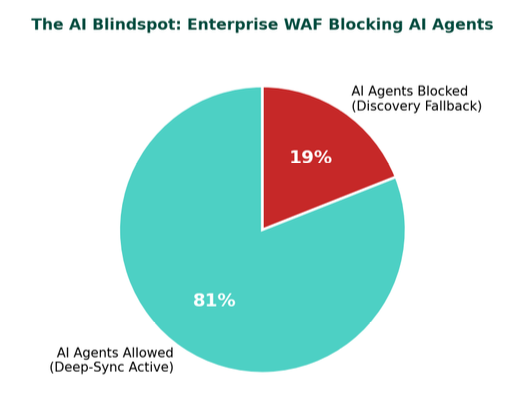
30% of top agencies received what we call an Engineering Alert verdict — meaning their brand authority is strong from an AEO (Answer Engine Optimization) perspective, but AI agents are physically blocked from navigating their site. These agencies are earning the reputation. They're just not capturing the citations.
The mechanism is usually an enterprise WAF (Web Application Firewall). Agencies deploy aggressive Cloudflare or equivalent configurations to protect against scrapers and bot attacks — completely reasonable. But these firewalls don't distinguish between a malicious actor and Google's agent. They throttle both.
19% of agencies were classified as Discovery Mode — meaning their infrastructure configuration restricted full AI agent navigation, limiting our scanner to metadata-only analysis. Agents fall back to what they can reach: search snippets, cached content, public metadata. The full site content becomes inaccessible.
The fix isn't to disable your WAF. It's to configure it to recognize legitimate AI agent user agents as trusted visitors — the same way you'd whitelist your own monitoring tools.
Finding 2: 83% Have No AI Agent Configuration in robots.txt
The robots.txt standard was built for a world of traditional crawlers — Googlebot, Bingbot, the familiar user agents SEOs have configured for three decades. AI agents have their own user agents. Permitting them — or failing to — is a distinct configuration decision.
Of the 100 agencies analyzed:
- 2 agencies explicitly permitted AI agent crawlers
- 2 agencies had partial or ambiguous directives
- 5 agencies were actively restricting AI agent user agents
- 83 agencies had no AI agent configuration whatsoever
Eighty-three percent of the top SEO agencies in the country have not yet addressed the question of AI agent access in their robots.txt. This is not a criticism of their service quality — it reflects how new this challenge is. But it is a problem that can be fixed in an afternoon.
Finding 3: 63% Are Losing Citations to moz.com
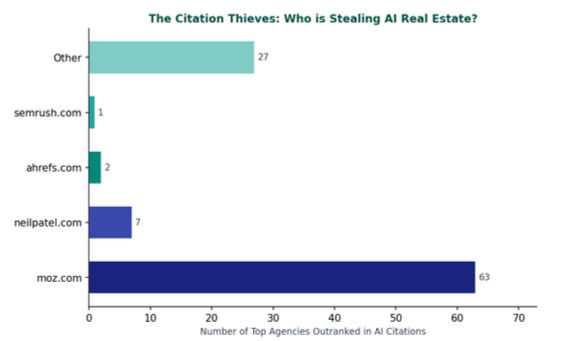
For each agency in the study, GEO Stellar identified which competitor is currently capturing AI citations for queries where the agency should be the natural answer. The results were striking in their concentration.
moz.com is the primary citation thief for 63 of the 100 agencies — nearly two-thirds of the sample. Neil Patel's site captured citations from 7 agencies. Search Engine Land from 6.
This isn't a story about Moz being a better SEO agency. Moz is winning because its content is better structured for AI parsing: denser schema markup, cleaner HTML, clearer topical authority signals. That structural advantage is entirely replicable. The agencies losing to Moz aren't losing on expertise — they're losing on engineering.
"An agency with 100 five-star Clutch reviews can still lose an AI citation to a blog post with better-structured HTML. In AI search, structure beats reputation."
Finding 4: The Agentic Friction Scatter
When we plot Agentic Friction™ score against Agent Readiness Score across all 100 agencies, the relationship is nearly perfectly linear. This tells us something important: the readiness gap is not a content quality problem or a brand authority problem. It is a structural engineering problem — one that can be diagnosed precisely and fixed with code.
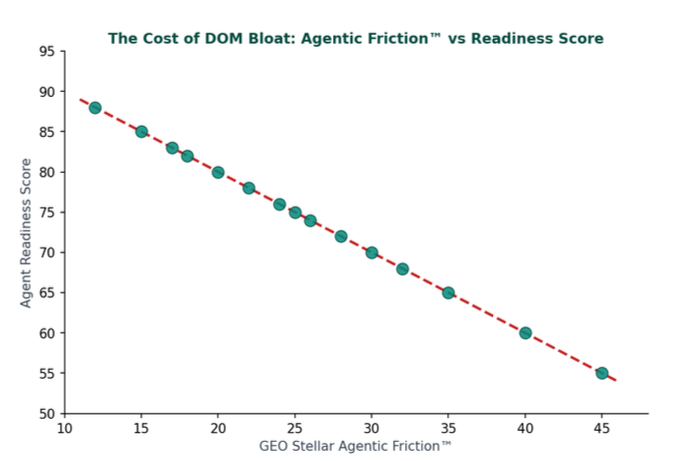
The agencies that scored highest share a consistent pattern: low DOM complexity, consistent schema.org markup across service pages, comprehensive ARIA label coverage, and WAF configurations that permit legitimate AI agent traffic. None of these are exotic techniques. They are the application of sound technical principles to a new audience — AI agents instead of human users.
What This Means for Your Agency
If you run an SEO agency, this report is an invitation to audit your own house before your clients or competitors do it for you. The questions to start with:
- What is your agency's current Agent Readiness Score?
- Have you configured robots.txt to permit AI agent crawlers?
- What is your WAF's posture toward AI agent user agents?
- What is your ARIA label coverage across your key service pages?
- Which competitor is currently capturing AI citations for your core queries?
If you are a business that works with an SEO agency, these are the exact questions to ask your agency partner — along with one more: What is your own Agent Readiness Score?
The Full Report
The complete research report — "The Agentic Readiness Gap: How America's Top 100 SEO Agencies Perform in the Age of AI Agent Search" — is available as a free download at geostellar.ai/report. It includes the full data tables, scoring methodology, per-agency findings, and actionable recommendations for agencies at every readiness level.
You can also run your own domain through the GEO Stellar platform directly. During our current Founding Members phase — capped at 25 agencies — you get Enterprise access at $199/mo locked permanently, dedicated M2 compute per account, and a permanent listing in our Agentic Vanguard directory as a pioneer in AI Search.
The era of AI agent search is not coming. It is here. The only question is whether your website is ready for it.
— Samir, Founder, GEO Stellar
All analysis was conducted on publicly accessible websites. Agency names are referenced for factual research purposes consistent with fair use principles. This report makes no claims about agency service quality or client outcomes — only the technical readiness of their own websites for AI agent search.